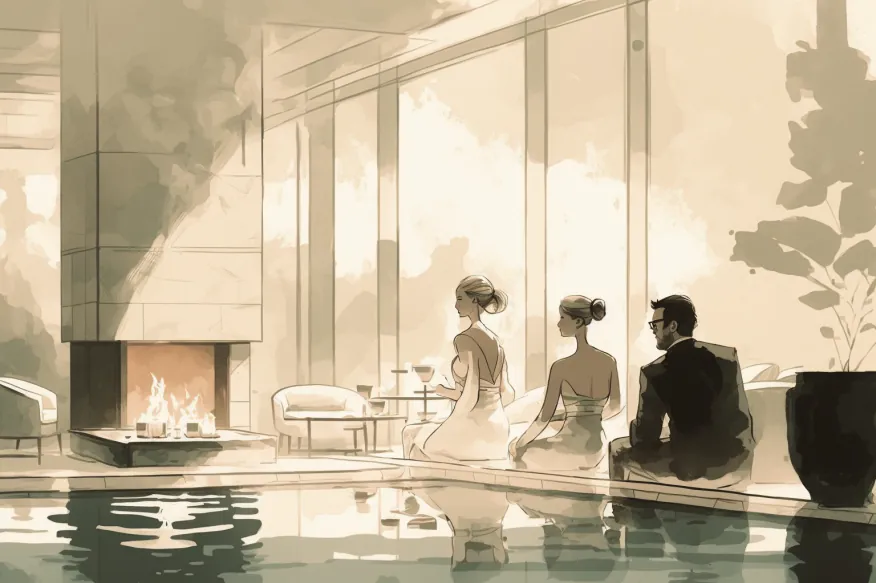
Wellness centers rarely get the basics wrong anymore.
The space is beautiful. Treatments are high-quality. Staff is trained. Materials are carefully chosen.
But many guests take too long to relax — or never fully relax at all.
This isn’t a luxury problem.
This is a transition problem.
Relaxation isn’t a switch
The most common assumption in the wellness industry: “If everything is calm, people will relax.”
But guests arrive from traffic. From work. From stress. With a nervous system running hot.
- The body resists — the nervous system isn’t ready for an abrupt shift.
- Discomfort sets in — the guest feels something is wrong but can’t name it.
- Relaxation gets delayed — instead of enjoying the treatment, the body fights the change.
The body must exit stress first — only then can it enter calm.
The most common mistake in premium wellness spaces
The most common mistake isn’t wrong atmosphere.
The most common mistake is skipping the regulation phase.
Wellness spaces often start:
- Too quiet — the nervous system has no anchor.
- Too slow — the rhythm doesn’t match the state the guest arrives in.
- Too ethereal — lacks the concreteness that grounds.
For the guest’s nervous system, this is an abrupt contrast. A mismatched signal. A reason for internal tension.
Why “silence” often doesn’t calm
Complete silence doesn’t create peace. It creates controlled stress.
Complete silence:
- Amplifies internal monologue — thoughts get louder.
- Increases self-awareness — the guest becomes aware of every movement.
- Emphasizes every small sound — footsteps, breathing, noises.
Guests become tense. Afraid to “disturb the peace.” They stay mentally active.
That’s not relaxation. That’s controlled stress.
Transitions matter more than treatments
The wellness experience isn’t just the massage, sauna, or treatment.
The most important parts of the wellness experience
Entering the space
First contact with the space. This is where transformation begins — or resistance does. An abrupt shift from the outside world to complete silence often causes discomfort.
Waiting
A missed opportunity for regulation. Most wellness spaces treat waiting as “dead time” — but it’s actually a crucial phase for preparing the body.
Moving between zones
Every transition is an opportunity to gradually reduce arousal. Or an opportunity to reactivate stress if the contrast is too sharp.
Returning 'to the world'
A neglected moment. A guest who exits deep relaxation directly into reception noise — loses part of the treatment’s effect.
If these transitions aren’t gradual, emotionally guided, and predictable — the treatment does its job, but the experience doesn’t stay deep.
How the best wellness spaces think
The best wellness centers don’t ask: “Is everything calm?”
They ask: “Is the guest being gradually guided from stress to peace?”
That means:
- Controlled tempo — each zone has its own rhythm matched to that phase of the experience.
- Clear spatial sequence — the guest knows what comes next, the body can prepare.
- Absence of sharp contrasts — transitions are gentle, almost imperceptible.
Peace then comes on its own. Without effort.
Sound as a problem indicator
Like in other industries — music rarely causes the problem, but it reveals it fast.
Wellness as lowering the level
Wellness isn’t a destination.
It’s a path toward a lower level of arousal.
Every phase needs:
- Slightly less stimulation — gradual reduction of input.
- Slightly more safety — predictability creates a sense of protection.
- Slightly more predictability — the brain can “switch off” when it knows what to expect.
Skip one phase — and the body stays tense, regardless of treatment quality.
What this means for an owner or director
If you want deeper guest relaxation:
Don’t start with treatments. Don’t start with design.
Start with the question: “Are we helping the guest’s body gradually calm down — or are we expecting it to do that on its own?”
Questions for self-assessment
- What’s the transition between reception and the wellness zone? Is there gradualness or an abrupt change?
- What does the guest hear while waiting? Silence that amplifies tension or sound that calms?
- Is there a clear spatial sequence? Or is everything “peace” from the first step?
- What does the return look like? Is there a gradient toward normal rhythm?
In wellness, luxury isn’t enough
Peace isn’t automatic.
Relaxation isn’t instant.
Relaxation is the result of good transitions, clear rhythm, and a sense of safety.
Wellness spaces that understand transitions don’t force peace. They guide the body where it wants to go.
Quiet. Gradual. Effective.
And the guest feels it — even when they can’t explain why.
Resources
- ASCAP (American Society of Composers, Authors and Publishers)
- Literature on the psychology of relaxation available in academic databases
Related topics
- Wellness spa sound and regulation
- Atmosphere diagnostics in hospitality
- Luxury hotels and designed silence
- Wellness guest anxiety