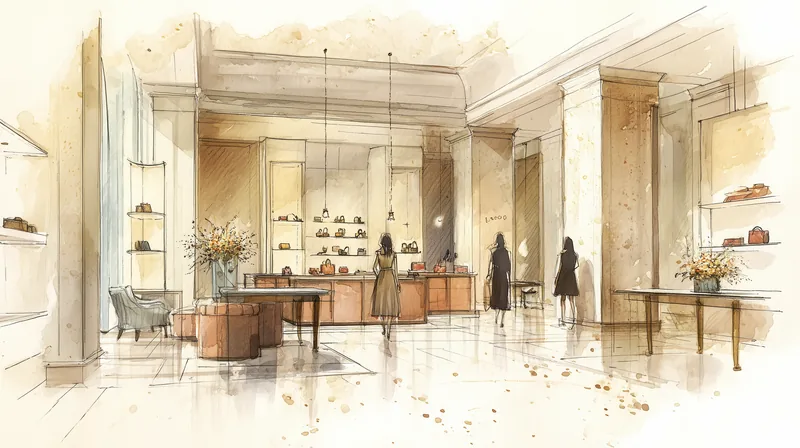
Many retail spaces have “good numbers.”
Solid footfall. Steady traffic. Decent sales.
But growth stalls.
Not because there aren’t people. But because people pass through—without staying.
Traffic measures entry. Engagement measures the decision to stay.
The decision happens before the shopper stops
Shoppers don’t enter retail with intent to linger. They don’t plan to stay. They don’t give the space a “second chance.”
The decision is made in motion. In seconds.
Signals the space must communicate
Safety
Is this a place where I can relax?
Openness
Am I welcome here?
Orientation
Do I know where to go?
If the space doesn’t communicate these three signals clearly, the shopper moves on. No frustration. No complaint. No trace.
The most common mistake: optimizing for numbers, not behavior
Retail often optimizes through:
- Promotions — “Now 30% off.”
- Discounts — “Buy two, get one free.”
- Visual campaigns — Posters, screens, signage.
But shopper behavior doesn’t change through discounts, volume, or aggression.
The threshold as critical zone
The most expensive zone in retail isn’t the shelf. It’s the threshold.
If the threshold feels closed, chaotic, or lacks a clear “welcome signal”—the shopper slows, looks, and moves on. No conscious decision made.
The signal at the threshold must say:
- “You’re welcome here.”
- “It’s safe to enter.”
- “You’ll find your way.”
Only with this signal does the shopper transition from “passerby” to “visitor.”
Why shoppers leave faster than they planned
Even when they enter, many shoppers circle quickly, don’t go deeper, leave without clear reason.
| Problem | Symptom | Consequence |
|---|---|---|
| No internal rhythm | Everything at the same level, no progression | Shopper doesn't know where to stop |
| No clear phases of stay | Entry, middle, exit—all the same | No sense of journey |
| No sense of 'what's next' | Shopper doesn't know where to go | Quick exit |
Spaces without defined dynamics lose shoppers for no visible reason
The shopper can’t articulate the problem. But they feel it. And so—they leave.
Small decisions that kill engagement
Examples retail often underestimates:
- Same ambience all day — Morning, afternoon, evening—everything sounds the same.
- Abrupt energy shifts — No transitions, no gradients.
- Mismatched tempo across the space — Different sections have different characters without logic.
How the best retail brands think
The best retail spaces don’t ask: “How do we sell more?”
They ask: “How do we make the shopper feel safe enough to stay?”
Clear entry signal — A threshold that invites, not repels.
Predictable internal rhythm — The shopper knows what to expect.
Ambience that requires no effort — A space that feels comfortable without thinking.
The shopper then slows, looks, decides.
Sound as indicator of space condition
As in other industries, music rarely creates the problem—but reveals it quickly.
If sound:
- Doesn’t follow shopper movement — Too fast or too slow for the purpose.
- Doesn’t support slowing down — Doesn’t signal that it’s OK to stop.
- Feels aggressive or empty — Doesn’t communicate the space’s character.
This means the retail space has no defined dwell dynamics.
Sound is the first indicator, not the cause.
Retail as journey, not warehouse
A retail space isn’t a place where goods are viewed. It’s a journey through decision.
Every part of the space must:
- Have purpose — Why would a shopper be here?
- Have energy — What feeling does the space create?
- Have direction — Where does the shopper go next?
Without this, the shopper isn’t wrong—they simply leave.
What this means for owners and brand managers
If you want more engagement:
- Don’t start with promotions — Discounts attract, but don’t retain.
- Don’t start with campaigns — Marketing brings people, but doesn’t create decision.
- Start with a question: “Does our space feel like a place where it’s comfortable to stay?”
If the answer isn’t clear—engagement will always be limited.
Traffic vs. engagement
| Aspect | Traffic | Engagement |
|---|---|---|
| Measures | Interest | Trust |
| Focus | Entry | Stay |
| Result | Visit | Decision |
| Value | Short-term | Long-term |
Traffic shows interest, engagement builds return
Retail spaces that understand this:
- Don’t push shoppers. Don’t rush the decision.
- They make staying easier.
And staying is what creates decision, justifies price, builds return.
Resources
- ASCAP: www.ascap.com
- BMI: www.bmi.com
- SESAC: www.sesac.com
- Literature on shopper behavior in retail: available in academic databases