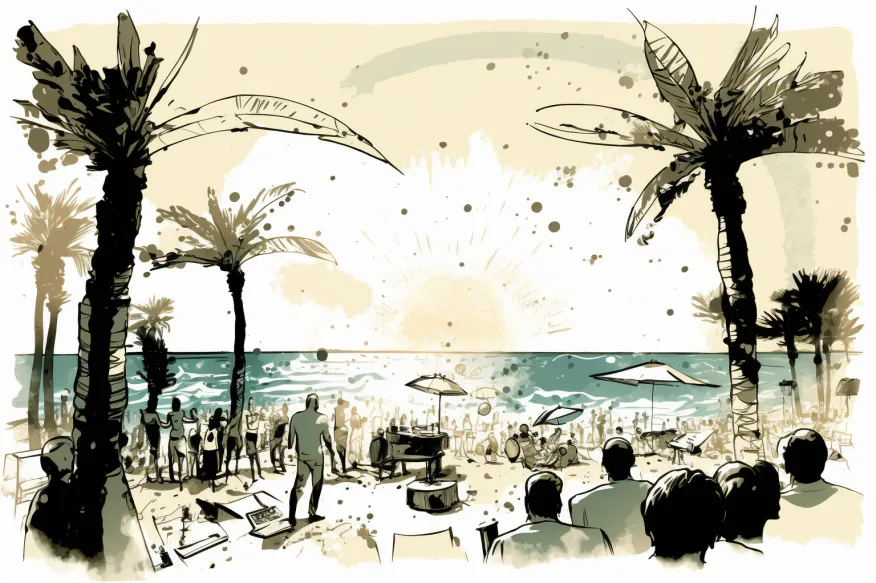
Party music has one primary job.
Move the body. Suspend analytical thinking. Create the feeling that “now” is the only moment that exists.
This isn’t a subtle genre. Not for every space. But in the right context—it has a measurable effect on behavior.
The Physiological Mechanism
Party music—house, dance, disco, upbeat pop—is characterized by high tempo. Usually 120+ BPM.
At that speed, the body responds.
Characteristic tempo of party music
Elevated sense of pleasure and reward
'Now' becomes dominant
Heart rate increases. Arousal rises. Dopamine releases. The guest enters a state of elevated energy with recognizable consequences.
Impulsivity increases. In a state of high arousal, cognitive control weakens. Decisions happen faster, with less analysis.
Focus narrows. “Now” becomes dominant. Past and future lose weight.
This is a state that—in the right context—the space wants to trigger. Party music isn’t just sound. It’s a tool for altering states of consciousness.
Impact on Consumption
In bars, party music has a documented effect on spending.
Fast tempo = fast consumption. Intervals between sips shorten. Glasses empty faster.
But it’s not just speed. Order frequency rises too.
The Turn-Over Effect
Party music accelerates everything—including departures.
Guests don’t stay for hours. The space “pushes” forward. Energy doesn’t allow stagnation.
This can be an advantage or disadvantage, depending on the goal.
For a space that wants rotation—a nightclub, a beach bar with limited capacity—turn-over is the goal. More guests through the evening means more revenue.
For a space that wants guests to stay—fine dining, a wine bar—party music is counterproductive.
Loss of Price Sensitivity
There’s a phenomenon connected to high energy: reduced price sensitivity.
In a state of elevated arousal, the cognitive effort needed to calculate “is this expensive”—drops. Guests analyze less. React more.
This is why nightclubs can charge high prices for drinks. The context—music, energy, state of arousal—reduces critical evaluation.
For seasonal sales, time-limited promotions, “now or never” offers—a party atmosphere supports impulsive purchases.
Application Contexts
Party music has clear habitats—and places where it doesn’t work.
| Context | Party Music | Reason |
|---|---|---|
| Nightclubs | Yes | Natural habitat—high tempo, high volume, dance floor |
| Beach clubs | Yes | Daytime parties, sunset sessions, seasonal atmosphere |
| Bars during peak hours | Yes | Friday and Saturday nights—energy is already rising |
| Fast-fashion retail | Yes | Speed and excitement encourage impulsive buying |
| Fitness centers | Yes | Cardio zones, high-intensity group training |
| Morning hours | No | Feels aggressive—guests seeking calm will leave |
| Business contexts | No | Signals unseriousness at a client lunch |
| Spaces for conversation | No | Wine bar, romantic dinner—prevents conversation |
| Older demographics | No | Audiences over 45 often experience it as exhausting |
Analysis of party music application contexts in hospitality
Timing is Critical
Party music only works at the right moment.
Guest isn't ready, feels attacked
Energy has already dropped, feels forced
Music amplifies energy that already exists
This requires reading the space. The right moment is when music raises energy that’s already present. Amplifies what exists—doesn’t impose what’s missing.
Power and Danger
Party music is the most powerful tool for raising energy. But also the riskiest for wrong application.
In the right context—a beach club on Saturday night, a nightclub at peak—party music transforms the space. Creates an experience that’s remembered.
In the wrong context—a cafe on Monday morning, a restaurant during a business lunch—party music drives guests away.
The difference isn’t the music. The difference is the context. A space that understands when party music makes sense—and when it doesn’t—uses the tool. A space that plays the same energy all day—uses nothing. Leaves results to chance.