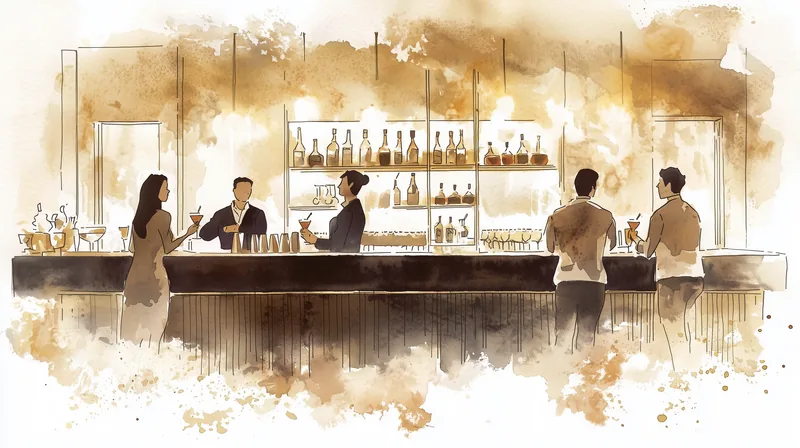
Lounge music has a paradoxical goal.
It’s designed to be present but unnoticed. To fill a space but not demand attention. To exist—without being thought about.
This isn’t a flaw. It’s the intention.
In hospitality, lounge serves a specific function that differs from all other genres. It isn’t there to entertain. It isn’t there to impress. It’s there to create a space where time is perceived differently.
The structure of invisibility
Lounge music has structural characteristics that make it “invisible.”
Stable patterns the brain stops tracking
Sounds that 'float' without clear structure
No peaks, drops, or surprises
Repetitive rhythms. Stable, predictable patterns that repeat without dramatic changes. The brain registers them once and then stops paying attention.
Ambient textures. Sounds that “float” instead of march. No clear beginning, middle, and end—just continuous flow.
Absence of dramaturgy. No peaks, no drops, no surprises. An emotional flatline that extends into infinity.
These characteristics make lounge ideal for spaces where music must not be the topic. Where the guest arrives with a different goal—a business meeting, relaxation, waiting—and music needs to support that goal, not compete with it.
Time perception
Lounge has a measurable effect on time perception.
In spaces with a stable lounge backdrop, guests consistently underestimate how long they’ve stayed. One hour feels like forty minutes. Two hours feels like an hour and a half.
This isn’t an illusion. It’s a consequence of how the brain processes time.
The brain measures the passage of time partly through external signals. Changes in the environment, events, transitions. When those signals are absent—when everything is stable, repetitive, unchanging—time perception stretches.
Lounge eliminates those signals. No clear beginnings and endings. No moments that mark “now ten minutes have passed.” Time becomes continuous flow without markers.
The physiological effect
Lounge works at the level of the body, not just the mind.
Stable rhythms tend to synchronize with bodily rhythms—heartbeat, breathing. A slower, more stable tempo “pulls” those rhythms downward.
Stress hormone drops with relaxing music
Shoulders drop, body releases tension
In spa centers, this is the obvious goal. The guest comes to relax, and music supports that intention.
But the same mechanism works in other contexts. A business traveler waiting in a hotel lobby with lounge music feels less tense than in silence or with more energetic music. A guest at a bar waiting for a friend checks their watch less often.
This stress reduction has economic value. A relaxed guest spends more. A relaxed guest leaves better reviews. A relaxed guest returns.
Transitional zones
Lounge has specific application in transitional zones—spaces between spaces.
Hotel hallways. Elevators. Receptions. Waiting areas. These spaces have no purpose of their own. They only connect purposeful spaces.
This is especially important in luxury contexts, where every moment should “belong” to the experience. A hallway without music feels like backstage. A space not meant for guests. A hallway with lounge music feels like part of the whole.
Application contexts
Lounge has natural habitats in hospitality.
Spa and wellness
Here lounge is almost the automatic choice. The goal is relaxation, and lounge directly supports that. Repetitive rhythms, ambient textures, absence of dramaturgy—all of it serves the space’s purpose.
Hotel bars
Especially during afternoon hours, between lunch and dinner. “Siesta time” when the bar is nearly empty but must maintain atmosphere. Lounge fills the space without demanding an audience.
Lobbies
The space of first impressions, but also of waiting. Lounge signals relaxation and quality without dominating. The guest can talk on the phone, work on a laptop, wait for a taxi—music doesn’t interfere.
Co-working spaces
A relatively new context, but lounge has proven effective. A stable backdrop that doesn’t disrupt concentration, but fills the silence that would otherwise be uncomfortable.
Genre limitations
Lounge isn’t a universal solution. It has clear limitations.
Nuances within the genre
Lounge isn’t a monolith. It has variations.
More melody, for relaxation without sterility
For bars with a bit more energy
Almost no rhythm, maximum neutrality
Lounge effect without lounge associations
The choice of nuance depends on specific context and audience.
Invisibility as value
Lounge music does something most music doesn’t do: it succeeds at not being noticed.
In the context of personal listening, that would be failure. Music you don’t notice is music you’re not listening to.
In the context of hospitality, that’s the goal.
A guest who comes to a spa doesn’t come to listen to music. They come to relax. Music that demands attention defeats that purpose. A guest in a hotel lobby doesn’t come to enjoy a playlist. They come to wait, work, talk.
Lounge understands this logic. It’s designed for contexts where music needs to exist. But not dominate.
That invisibility is a skill. And it has value measured in longer stays, lower stress, better perception of the space.
Is lounge music suitable for all hospitality spaces?
No. Lounge has clear limitations. It isn’t appropriate for energetic evening spaces, younger audiences, or spaces with a pronounced identity. It works best in spa centers, hotel lobbies, afternoon bars, and transitional zones.
How does lounge music affect time perception?
By eliminating external signals of change—clear beginnings, endings, and dramatic transitions—lounge causes guests to underestimate how long they’ve stayed in a space. One hour can feel like forty minutes.
What’s the difference between lounge, chillout, and ambient?
Chillout is warmer with more melody, downtempo has a more pronounced rhythm, ambient is almost without rhythm with pure textures. All share the function of relaxation, but with different intensity and energy.