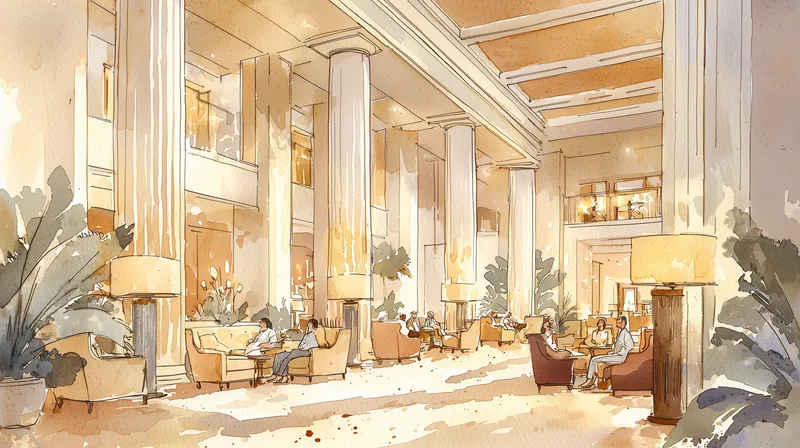
In hotels, music is often treated as a technical detail. Something that must exist, but doesn’t require special attention.
Hotels with a distinctive experience think differently.
For them, music isn’t a background item. It’s part of brand identity. An extension of architecture and interior design. A silent guide through the guest’s stay.
A hotel isn’t one space
This is the fundamental point that many overlook.
A hotel is a collection of different micro-environments:
Arrivals, waiting, orientation
Meals, conversation
Quiet, introspection
- Lobby — the space for arrivals, waiting, first impressions
- Restaurant — the place for meals, conversation, social ritual
- Bar — evening tempo, relaxation, a more intimate character
- Hallways — transitional zones, movement between spaces
- Wellness and spa — the space for recovery, quiet, introspection
- Rooms — privacy, rest, the guest’s personal space
- Outdoor spaces — terrace, pool, garden, where they exist
Each of these spaces has a different function. A different rhythm. Different guest expectations.
Thinking in zones
The approach that works starts from a simple premise: each zone has its role in the guest’s journey through the hotel.
Music doesn’t serve to “sound nice.” It serves to:
- Support the space’s function
- Not interfere with the primary activity
- Connect the experience into a whole
This requires a different approach for each zone.
Lobby: First and last impression
The lobby is the most emotionally charged space in a hotel.
This is where guests arrive — perhaps tired from travel, perhaps with expectations, perhaps nervous. This is where they leave — with a fully formed impression of the entire stay.
Music in the lobby should be:
- Present enough that the space “lives” — silence in a lobby creates a cold, sterile impression
- But restrained enough not to dominate — the guest communicates with staff, orients themselves, transitions into “hotel mode”
Daily dynamics
Lobby Music Through the Day
Morning & Midday
Fresher, more open energy. Guests are waking up, moving, have plans.
Afternoon
Softer transition. Returns from excursions, rest before dinner.
Evening
Warmer, calmer atmosphere. The day ends, tempo slows.
Restaurant and bar: Rhythm, not genre
Hotel restaurants and bars have a specific position. The guest is already in the hotel. They didn’t come specifically to the restaurant—they came for dinner during their stay. This changes the dynamic.
A mistake hotels often make
They copy the approach of external restaurants — but hotel guests stay longer and are more sensitive to atmosphere. Or they play the same music as in the lobby — which creates monotony.
Music in a hotel restaurant must
- Follow the course of the meal — from arrival to dessert
- Support conversation — guests often eat in pairs or small groups
- Build evening dynamics without forcing
The bar has a different function. Guests come here to relax, have a drink, perhaps socialize with other guests. Music can be more present, with more character. But still—part of the whole, not an isolated zone.
Hallways and common areas: Continuity, not silence
Complete silence in hallways has an unexpected effect.
- Emphasizes every sound—footsteps, closing doors, conversation from a room
- Creates a cold, institutional impression
- Breaks the continuity of experience
In hallways, music shouldn’t attract attention. It just accompanies. But its absence is noticed more than its presence.
Discreet, unobtrusive music does the opposite:
- Connects zones — the guest moves from lobby to hallway without a sense of “break”
- Softens transitions — less jarring shifts between spaces
- Gives a sense of thoughtfulness — someone considered this detail too
Wellness and spa: The most sensitive zone
In wellness and spa spaces, the wrong music can destroy the experience.
The guest comes to relax. Reduce stress. Step away from everyday life. Music must support that goal.
Professional approach
Wellness is the zone where music has the most direct effect on the guest’s physical state. This requires special attention.
Hotel rooms: A question of approach
The approach to music in rooms varies depending on the hotel concept.
Some options:
- TV with music channels — simple, but without control and consistency
- Integrated system — music available on demand, same style as the rest of the hotel
- No music — room as a space for quiet and the guest’s personal choice
There isn’t one correct approach. It depends on the hotel’s positioning, guest expectations, technical capabilities.
What’s important: if there is music in rooms, it should be consistent with the rest of the hotel experience.
Consistency: What guests can’t explain
Guests rarely say: “Your music was well set up.”
But they often feel:
- That the hotel is “more pleasant” than expected
- That the stay was calm, without friction
- That they want to return
This is the result of consistency—not perfection, but persistence.
Consistency means
Between zones — the transition from lobby to restaurant doesn’t create shock.
Through time — morning and evening atmospheres are different, but connected.
Throughout the stay — the first and last day have the same character.
The guest doesn’t analyze the music. They feel the whole. Consistency builds that whole.
Most common mistakes
Some mistakes are technical. Others are conceptual.
- One soundtrack for all spaces — ignores different functions of zones
- Recognizable songs that draw attention — the guest starts listening to music instead of music being in the background
- Too big a difference between zones — the restaurant has a completely different character from the lobby, and the guest feels the inconsistency
- Music without clear purpose — something plays, but nobody knows why that specifically
All of this creates an impression of improvisation. And improvisation is the opposite of a premium experience.
The legal dimension
There’s also an aspect that’s often overlooked.
Hotels have multiple zones, often with different music. This complicates licensing — each zone with music must be registered.
The music source must be intended for commercial use. Spotify from a personal account isn’t a legal solution — not for the lobby, not for the restaurant, not for the wellness area.
How hotels approach music long-term
Hotels that think long-term don’t handle music ad hoc.
They:
- Define the role of each zone — what that zone should achieve, and how music supports it
- Align music with the brand — sound becomes part of identity, not chance
- Establish a system that removes improvisation — staff don’t decide on music; the system does it consistently
- Resolve the legal framework — the license and source are arranged, and inspection isn’t a source of stress
Result: music becomes part of operational infrastructure, not an ongoing concern.
The guest’s perspective
The guest doesn’t come to a hotel because of music. They come because of location, service, amenities, price.
But music affects how they perceive everything else.
Space appears more expensive, thoughtful, professional
Something feels off—hard to describe, but it's there
Music isn’t the reason for coming. But it can be the reason for returning.