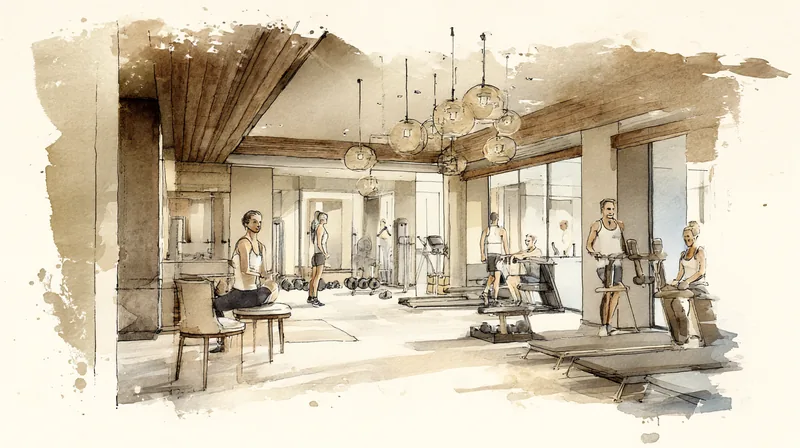
In gyms, music isn’t background noise. It’s part of the workout.
Research documents that properly selected music can reduce perceived exertion and increase endurance by double-digit percentages. A member with the right music trains more intensely and longer — while feeling less fatigued.
This isn’t a motivational slogan. It’s physiology.
Why tempo isn’t a matter of taste
BPM — beats per minute — isn’t just a number on a screen. It’s information the body uses.
The human body has a tendency to synchronize with external rhythm. Steps, heartbeats, breathing — all of these unconsciously “lock onto” the tempo of the music playing.
This isn’t a matter of preference. Music at 80 BPM on a cardio machine produces different results than music at 130 BPM — regardless of whether the member “likes” it.
Different zones, different tempos
A gym isn’t a homogeneous space. Radically different activities take place within the same building.
BPM for running and cycling
BPM for weight lifting
BPM for maximum intensity
BPM for recovery
Cardio zone (125–140 BPM)
Running, cycling, elliptical machines. Activities with continuous, repetitive movements.
Music here serves as a metronome. A high, steady tempo that encourages maintaining rhythm. The member “locks in” to the beat and keeps going.
Free weights zone (120–130 BPM)
Lifting weights requires focus, control, and strength. Music that’s too fast can disrupt concentration. Too slow a tempo doesn’t provide enough energy.
A medium tempo with strong, rhythmic beats — enough energy for motivation, enough space for focus.
HIIT and group classes (140+ BPM)
Extreme intensity demands extreme energy. Music here pushes members to “break through” their limits, to endure one more set, another thirty seconds.
This is the zone where music has the most direct impact on performance.
Yoga and stretching (60–90 BPM)
The opposite function. The goal is lowering heart rate, focusing on breathing, recovery.
Ambient tones, slow rhythms, minimal melodic complexity. Music that doesn’t demand attention — it simply supports the process.
Daily dynamics
A gym at 6 AM has different energy than a gym at 6 PM.
A single playlist for the entire day ignores differences in the space’s energy. The gym loses its ability to adapt to members’ needs.
Morning (6:00–9:00)
Members arrive before work. They need to “wake up,” get into the rhythm. Music can be upbeat, energetic, motivating — but not aggressive. The goal is to start the day.
Late morning (9:00–12:00)
A quieter period. Fewer members, often an older audience or people with flexible schedules. Intensity can be lower.
Afternoon (12:00–16:00)
Lunch breaks, students, freelancers. Mixed audience. Medium intensity that doesn’t assume a specific profile.
Evening “peak” (17:00–20:00)
The busiest period. Members arrive after work, often tense, needing to “blow off steam.” Maximum energy.
Late evening (20:00–22:00)
Those who prefer fewer crowds. Energy can start tapering off, preparing the space for closing.
Group programs as a special zone
Group classes — Pilates, CrossFit, cycling, yoga — have specific needs.
Each program has its own energy logic. Yoga requires calm. Cycling requires intensity. Putting them on the same music makes no sense.
Spaces beyond exercise
A gym also has zones that aren’t for training.
Reception and changing rooms
This is where members come and go. The energy should be welcoming, but not too intense. A transition between the “outside world” and training.
Cafe or protein bar
If the gym has a space for socializing after workouts, it requires a different atmosphere. More relaxed, more sociable, with lower intensity.
These zones are often neglected. They either have no music, or have the same as the main floor — which isn’t optimal.
The legal dimension
Gyms are under frequent scrutiny. Music is an obvious element of the business — it plays loudly, all day, in a public space.
Impact on member retention
There’s a connection between atmosphere and retention — how many members stay, how many leave.
A professionally curated atmosphere creates a sense of quality. Members feel they’re in a “real” facility, not an improvisation.
Poor or monotonous music has the opposite effect. Perhaps not consciously — members don’t cancel “because of the music” — but the overall experience is less enjoyable.
Retaining an existing member costs less than acquiring a new one. Atmosphere is one of the factors that influence this equation. Professionally curated music signals quality and attention to detail — which members recognize, even if they can’t articulate it.
How gyms approach music systematically
Gyms that take atmosphere seriously do several things:
- Map zones — which zones exist, what is the function of each
- Define tempo by zone — not the same BPM everywhere, but adapted to the activity
- Track daily dynamics — morning different from evening
- Separate group programs — each program has its own sonic identity
- Address the legal framework — licensing and source are sorted
The result: music becomes part of the workout, not an accident.
Resources
- ZAMP official website
- Research on music and physical exertion is available in academic databases
Related topics
- Music Licensing for Hospitality — Complete Guide
- Psychology of tempo and behavior
- Music for wellness spaces