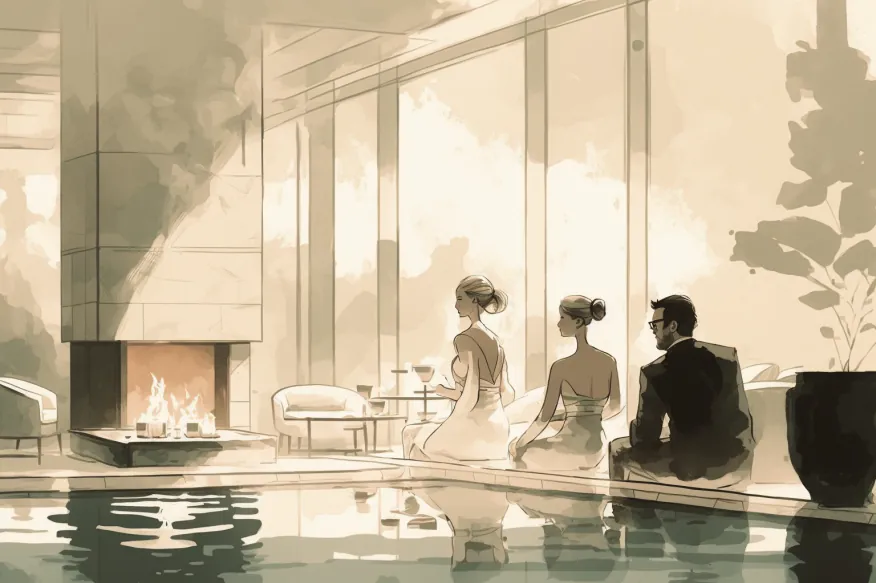
People rarely remember exactly what they ate.
Even more rarely what song they heard.
But they often remember how they felt.
This isn’t coincidence. It’s the result of a layered experience that doesn’t happen in one sense—but in all of them simultaneously.
The limitation of visual focus
Many spaces today are visually flawless.
Architecturally clean. Aesthetically consistent. Photographed for magazines.
But despite all that—they feel cold. They leave no trace. They don’t invite return.
The reason is simple: design is seen. Experience is felt. And feeling doesn’t happen through eyes alone.
How the brain processes space
The human brain doesn’t separate senses the way we talk about them.
There’s no “visual impression” separate from “auditory impression” separate from “spatial feeling.”
The brain merges everything into one—indivisible—sense of space.
Sound as the glue
Of all sensory layers, sound has a unique characteristic.
You can look away. You can close your eyes.
You can’t “unhear” a space.
Echo tells the brain how large a space is
Softens or amplifies emotional intensity
Fast music speeds up, slow music extends the stay
That’s why sound is the emotional glue between other elements.
Visual says: “This is what the space looks like.”
Sound says: “This is how you feel in it.”
Division of functions
Light and sound have different functions in a space.
Light determines focus
Where to look. Where to sit. Where to move.
Light is spatial—it speaks to geometry, to zones, to accents.
Sound determines mood
How long to stay. How much to relax. How open to be in conversation.
Sound is temporal—it speaks to duration, to rhythm, to emotional state.
What is “core memory”
In hospitality, there’s a phenomenon that’s hard to measure but easy to recognize.
A guest who returns and says: “I felt good here.”
Not “the food was excellent.” Not “the interior was beautiful.” Not “the music was perfect.”
Just: “I felt good.”
That’s core memory. A feeling that remains after the details are forgotten. A feeling: “I felt good here—and I don’t know exactly why.”
Core memory is not:
- The wow effect — an impressive moment remembered as “spectacle”
- The Instagram moment — a visually striking frame
- A recognizable element — something that can be described and shared
Core memory happens when:
- Nothing bothers — no element stands out demanding attention
- Nothing dominates — no sense is overwhelmed
- Everything holds the line — cohesion the guest doesn’t analyze, only feels
The most common mistake
The most common multisensory mistake isn’t bad music. Or bad lighting.
The most common mistake is designing each layer separately.
The architect finishes. The lighting designer adds their layer. Music comes at the end—as a “finishing touch.”
How spaces with strong identity think
Spaces that guests remember—and return to—share something in common.
Focus isn't on 'wow'—it's on the guest feeling good
No sense is attacked, everything stays in balance
Transitions are subtle, morning flows into day into evening
In such spaces, sound doesn't lead—it holds the whole together
Design for memory
Spaces that create core memory don’t focus on individual elements.
They focus on harmony.
Sound supports light. Light respects space. Space enables sound.
Everything communicates in the same language.
The guest doesn’t analyze that communication. They just feel it. And remember.
They don’t remember the playlist. They don’t remember the light fixture. They don’t remember the wall color.
They remember how they felt while they were there.
And that feeling only happens when all layers speak the same language.
What is multisensory experience in hospitality?
Multisensory experience is the perception of a space created by the combination of all sensory layers—sight, hearing, spatial awareness. The brain doesn’t process these layers separately. It merges them into a unified feeling that determines how a guest feels in the space.
Why can a visually perfect space feel cold?
Design is seen, but experience is felt. A space can be architecturally flawless, but without harmonized sound and light it creates no emotional imprint. All sensory layers must work together.
How do you avoid fragmented space design?
Instead of each specialist working on their layer separately, multisensory planning must be integrated from the start. Sound, light, and space must be designed in parallel, with the same emotional goal.