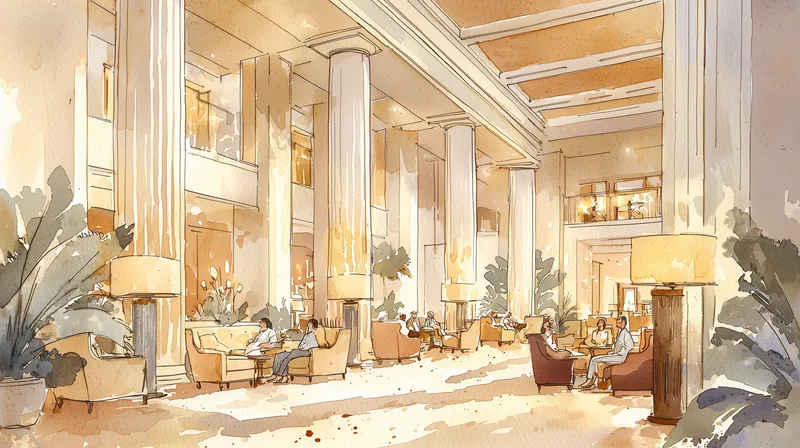
Large hotels and resorts are complex systems. Different rhythms of life happen simultaneously.
While the lobby buzzes with check-ins, the spa a few meters away demands absolute silence. The restaurant prepares for an intimate dinner. All at once.
Managing these different sonic needs from a single source—or leaving each zone to individual staff preferences—creates what can only be called operational chaos.
Why one sound source is no longer enough
In smaller properties—boutique hotels, single-room restaurants—one music source can work.
But the moment a property has multiple functional areas, one source becomes a limitation. Lobby and spa can’t share the same music. Restaurant and fitness center have opposite needs.
Functional zones in large hotel properties
Every large hotel has at least five functional zones when it comes to sound:
Five Functional Zones in Hotels
Lobby and Reception
The first impression zone. Music must be sophisticated, welcoming, neutral. Too loud repels. Too quiet creates emptiness.
Restaurants and Bars
Zones requiring adaptation to service times. Breakfast, lunch, and dinner each demand different tempo.
Wellness and Spa
Focus on low frequencies and slowness. Here music must practically disappear.
Fitness Center
High energy, fast tempo, clear motivation. The opposite of everything else.
Hallways and Transitional Spaces
Subtle background maintaining continuity. Almost invisible. But present.
Two extremes that don’t work
The uniformity problem
The most common mistake: same music or playlist for all zones.
Works on paper. In practice, uniformity means music is inappropriate in at least half the spaces. Too fast for spa. Too slow for fitness. Too undefined for lobby.
The result isn’t consistency — it’s mediocrity everywhere.
The total autonomy problem
The opposite mistake: each zone picks its own music independently.
This leads to another problem — sonic chaos. A guest moving from restaurant to lobby experiences discontinuity. Each space “sounds” like it belongs to a different property.
The result isn’t flexibility — it’s fragmentation.
Balance: central logic, local adaptation
The solution lies between two extremes.
| Approach | Control | Flexibility | Consistency | Recommendation |
|---|---|---|---|---|
| Single source for all | Yes | No | Partial | Not for large properties |
| Total zone autonomy | No | Yes | No | Creates fragmentation |
| Central logic + local adaptation | Yes | Yes | Yes | Optimal approach |
Comparison of music management approaches in multi-zone spaces
Central logic — defines the framework: what type of sound belongs in which space, what tempo, what volume, what energy.
Local adaptation — enables fine-tuning within that framework: the restaurant manager can adjust volume without affecting the spa.
This isn’t a compromise. It’s architecture.
Eliminating human error
One of the biggest risks in multi-zone spaces is dependence on staff.
- The waiter who forgets to start the music
- The receptionist who sets volume to personal taste
- The therapist who plays their private playlist
Automating daily transitions—morning, midday, evening—eliminates most of these situations. The system moves from one phase to another without human intervention.
Staff stays involved. But for exceptions, not routine.
Acoustic isolation
In complex properties, sound travels.
Energetic music from the fitness center can reach the spa relaxation zone. Restaurant chatter can drift into the lobby bar. Music from transitional spaces can “contaminate” zones that need quiet.
Physical acoustic isolation is ideal. But not always possible.
Transitions between zones
Guests don’t experience a hotel as a collection of separate spaces. Guests move.
From lobby to restaurant. From restaurant to spa. From spa to room.
Each transition involves a change in sound. If changes are too sharp, the guest feels discontinuity.
Transitional zones — hallways, elevators, stairwells — serve as acoustic buffers. Spaces of neutral sound that enable transition between energetically different zones.
Legal compliance
In multi-zone spaces, the legal aspect of music becomes more complex.
Often the lobby is covered by a license, but the spa uses a personal streaming account. Or the restaurant is registered, but the fitness center isn’t.
When to split a zone
The question “do we need another zone” comes up regularly.
The rule: a zone should be separate if:
- The space has doors or physical separation
- The space’s function differs from its neighbor
- The audience has opposite needs
Example: a pool used by families and guests seeking quiet—may need time-based division or physical separation into “family” and “quiet” sections.
Example: a lobby that becomes a cocktail bar in the evening—may need two modes within the same zone, not two separate zones.
Complexity as opportunity
Managing a multi-zone property isn’t simpler than managing a single zone.
But a well-designed system transforms complexity into advantage. Each space gets its atmosphere. Each guest gets an experience tailored to what they’re seeking.
- Lobby — welcomes with arrival energy
- Restaurant — feeds with service rhythm
- Spa — rests with depth of quiet
- Hallways — connect without interruption
This isn’t a series of accidents. It’s experience architecture.
A hotel that understands its zones doesn’t manage music. It manages atmosphere. And atmosphere is what guests remember—and what brings them back.
Resources
- ASCAP — US performing rights organization
- BMI — US performing rights organization
- PRS for Music — UK performing rights organization
- Acoustic architecture: specialist literature on architectural acoustics