In premium hospitality, luxury is rarely defined by what’s present.
It’s defined by what’s eliminated.
While average operators try to fill every square meter with visual or auditory stimulation, top-tier hotels understand something different. Silence is the most expensive material they can offer a guest.
Accidental Silence vs. Designed Silence
Most properties treat silence as “emptiness.” An absence of sound. Something that happens when the music stops.
In that context, silence is uncomfortable. It amplifies the clatter of cutlery, the hum of air conditioning, muffled staff conversations. Creates a sense of abandonment or sterility.
Designed silence isn’t absence. It’s presence of a different kind.
Designed silence is something else entirely. An intentional sonic pause. A moment where architecture, light, and space come into focus — because sound is no longer competing for attention.
Absence of sound that amplifies unwanted noise
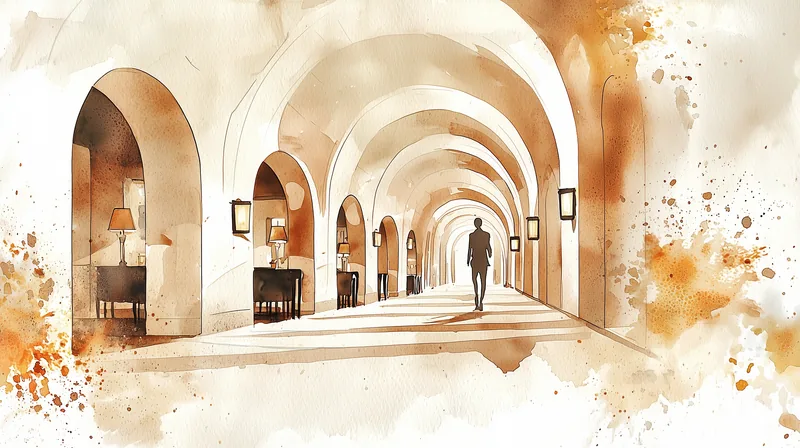
Intentional pause that lets architecture breathe
Silence as a Transition Tunnel
Luxury hotels use silence strategically — as an “acoustic decompression tunnel.”
A guest entering the hotel arrives with the outside world in their head. Stress, noise, information overload. Their nervous system is in activation mode.
If they’re immediately greeted by another form of stimulation — lobby music, reception chatter, bar ambience — the transition is too small. The brain stays in the same mode.
A designed transition looks different:
Lobby
Sound that communicates welcome, but not aggressively. Gentle energy signaling: ‘You’ve arrived.’
Hallways
Zone where sound gradually fades. Preparation for privacy.
Room
Complete guest control over the sonic environment. No sound without their choice.
Negative Space in Sound
In visual design, negative space is the emptiness that gives meaning to the object. Without it, everything becomes chaos.
The same logic applies to acoustic design.
Becomes noise
Becomes fatigue
Exhausts
Luxury hotels understand that silence gives context to sound. That pause amplifies impact. That absence can be more powerful than presence.
That’s why they design silence — with the same care they design sound.
Predictability as Luxury
A guest paying a premium price isn’t just seeking a room. They’re seeking predictability of an exceptional experience.
If the lobby sound at 10 AM is completely different from 6 PM — the brain registers dissonance. If the restaurant atmosphere contradicts the visual identity — perceived quality drops.
This confirmation isn’t conscious. The guest doesn’t analyze what they hear. But they feel the difference between a space that’s “guided” and a space that’s “happening.”
What Silence Does to the Body
Constant sonic stimulation keeps the nervous system in activation mode.
Even pleasant music — if constantly present — requires a certain level of processing. The brain never fully switches off.
Designed silence sends signals to the parasympathetic system: you can relax. No threat. No need for alertness.
Guest arrives at room more ready for rest
Transformative, not just pleasant
Focus that's impossible elsewhere
This isn’t aesthetics. It’s physiology applied to space.
Why Silence Has a Price
Designed silence isn’t free.
It requires architectural attention. Insulation, materials, acoustic treatment — all of this has a cost.
It requires operational discipline. Staff who understand that “quiet” doesn’t mean “abandoned.”
It requires strategy. Knowing where silence makes sense, and where sound must take over.
Invisible Signals
Guests rarely remember a specific song that played in the hotel.
But they always remember how they felt.
That feeling is the result of balance — the perfect ratio of sound that supports the space and silence that supports the guest.
Hotels that achieve this balance stop being just places to stay. They become places for transformation.
They don’t just offer a roof overhead. They offer peace as a luxury product.
Silence as Differentiation
In a market where everyone offers “luxury,” differentiation keeps getting harder.
Everyone has quality beds. Everyone has designer bathrooms. Everyone has an “experience” approach.
Silence — designed, intentional, strategic — remains one of the hardest things to copy.
Because it’s not enough to have a quiet space. You need to understand how silence functions in context. How it combines with sound. How it’s guided through zones.
That knowledge isn’t common. And that’s exactly why it’s valuable.
From “Dead Silence” to “Living Space”
In the end, the difference is in approach.
“Dead silence” is absence. Emptiness. Something that happened because nobody thought about sound.
“Living silence” is a decision. A material. Something designed with the same care as everything else in the space.
Luxury hotels that understand this difference offer an experience guests remember. Not because they heard something special. But because they finally — heard themselves.
What’s the difference between accidental and designed silence?
Accidental silence is emptiness that amplifies unwanted sounds — clattering cutlery, humming air conditioning, muffled conversations. Designed silence is an intentional sonic pause that lets architecture breathe and allows the guest to relax.
Why is silence important for the hotel guest experience?
Constant sonic stimulation keeps the nervous system in activation mode. Designed silence sends signals to the parasympathetic system to relax, resulting in better sleep, deeper relaxation, and clearer thinking.
How do luxury hotels use silence strategically?
They use it as an “acoustic decompression tunnel” — from a lobby with gentle energy, through hallways where sound gradually fades, to the room where the guest has complete control over the sonic environment.
Why is designed silence hard to copy?
It’s not enough to “turn off the music.” It requires architectural attention, operational discipline, and strategy. You need to understand how silence functions in context, how it combines with sound, and how it’s guided through zones.
What is “living silence” in the context of luxury hospitality?
It’s silence as a conscious decision and material — something designed with the same care as everything else in the space, as opposed to “dead silence” which is emptiness created because nobody thought about sound.
Resources
- ASCAP — US performing rights organization
- BMI — US performing rights organization
- PRS for Music — UK performing rights organization
- Literature on acoustic design in hospitality: available in academic databases