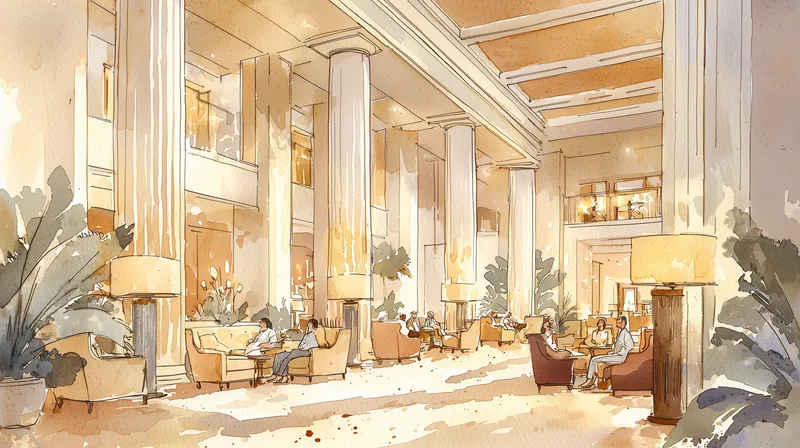
The lobby is not a background space.
In hospitality that thinks only about rooms, the lobby is a transit point. A place for check-in and check-out. A space the guest must pass through to get somewhere else.
In hospitality that thinks about experience, the lobby is something else. It’s the first point of contact with the brand. The space that sets expectations for everything that follows.
That shift in perspective changes everything—including the approach to sound.
First impression
The guest enters the lobby with the outside world still in their head. Street noise, travel stress, fatigue from the flight or drive.
In that moment, the lobby has a job: mark the transition. Signal to the guest that they’ve “arrived.” That they’re now in a different space, with different rules.
Sound is one of the most powerful tools for that transition. A lobby with thoughtful sound creates a moment. The guest feels the change. Shoulders drop. Breathing slows. The transition is marked.
A lobby without sound—or with the wrong sound—marks nothing. The guest stays in their previous state. The space doesn’t “catch.”
This happens in seconds. And it shapes everything that follows.
Multifunctional space
The modern hotel lobby isn’t one thing. It’s an ecosystem of functions.
Check-in, information, conversation with staff
Waiting, conversation, informal meetings
Laptops, phone calls, concentrated work
More relaxed atmosphere, socializing
Reception
Space for check-in, information, communication with staff. Sound here must enable clear communication. Discreet, present, but not competing with conversation.
Lounge zone
Space for waiting, conversation, meetings. Sound here has a different function—creating “acoustic barriers” that provide privacy in a public space. The guest can talk without feeling everyone hears them.
Work area
Many lobbies serve as informal business spaces during the day. Guests with laptops, phone calls, focused work. Sound here must support concentration. Not disrupt it.
Bar/café zone
If the lobby includes hospitality amenities, that zone has its own needs. More social, more relaxed, with different energy.
Daily dynamics
The lobby at 7 AM and the lobby at 11 PM are not the same space.
Lobby music through the day
Morning (6:00–10:00)
Check-out rush, guests heading to work or excursions. Energy is practical, focused. Sound can be brighter, more open—support for starting the day.
Late morning (10:00–14:00)
Quieter period. Less traffic. Sound maintains atmosphere without forcing energy that doesn’t exist.
Afternoon (14:00–18:00)
Check-in wave begins. Guests arrive tired from travel. Sound should signal welcome and calm—not assault with energy.
Evening (18:00–22:00)
The lobby transforms into a social space. Guests gather before dinner, return after going out. Atmosphere becomes warmer, more intimate.
Late night (22:00–6:00)
For those still awake—calm, discretion, a sense that the space “guards” their privacy.
Consistency as signal
A guest who arrives on Monday and a guest who arrives on Saturday should recognize the same hotel.
This doesn’t mean the same playlist forever. It means consistent character. A recognizable “sound signature” that isn’t aggressive but is present.
Consistency communicates professionalism. It signals to the guest: “Things here are not left to chance.”
A lobby where sound varies depending on who’s on shift—loses that message. The space feels more improvised than it should.
The legal dimension
The lobby is a public space with music. That means legal obligations.
- Licensing is required—as with any space with public music performance
- The source must be legal—Spotify, YouTube, personal playlists violate terms of service for commercial use
- International chains have a more complex situation—each country has its own organization (GEMA in Germany, SIAE in Italy, PRS in UK, ASCAP/BMI in US)
Sound and quality perception
There’s a connection between sound and quality perception that’s hard to articulate but easy to feel.
A lobby with thoughtful sound feels “higher quality.” The guest can’t explain why—but they feel the difference.
This transfers to expectations:
- A guest with a positive first impression in the lobby—expects quality in the room
- Expects quality in the restaurant
- Expects quality in the service
A lobby that leaves no impression—or leaves a negative one—sets lower expectations. Everything that follows must work harder to compensate.
The lobby as statement
Sound in the lobby isn’t “background.” It’s a statement.
How much the hotel cares about every element
At what level the hotel operates
What experience the guest can expect
That statement isn’t spoken. It’s felt. In the first seconds after entering the space.
A hotel that leaves this statement to chance leaves the first impression to improvisation. A hotel that thinks through this statement controls the experience from the first moment.